Yellow T10 Carbon Steel Katana
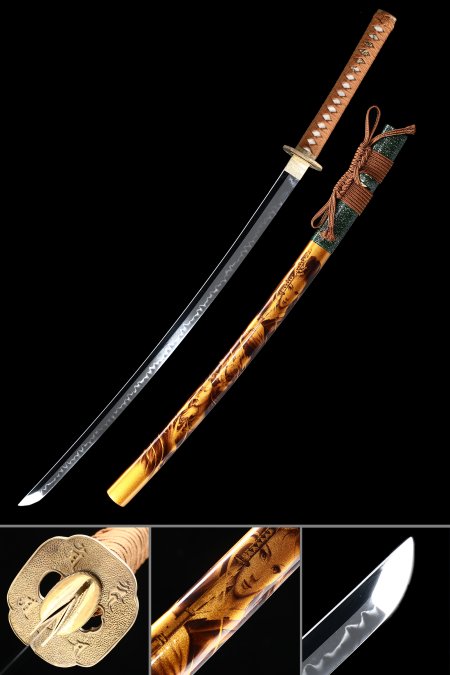
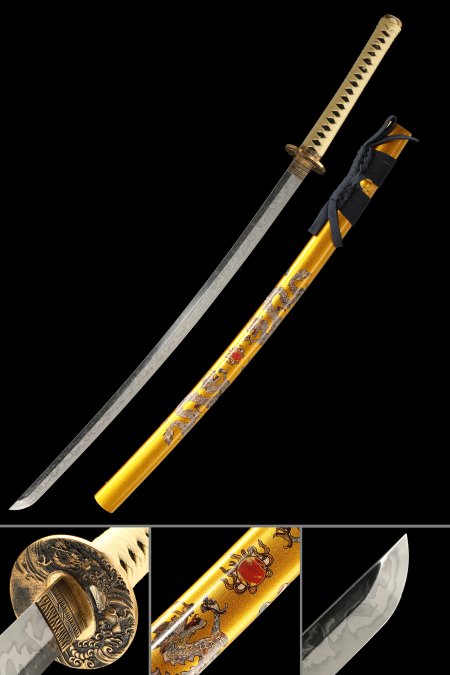
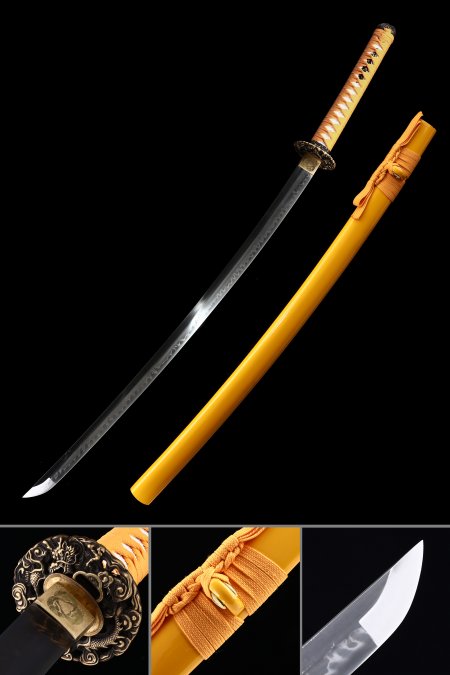
Few finishing choices announce a collector's taste quite like a yellow saya — bold, lacquered, and unmistakably intentional. Every katana in this collection pairs that striking aesthetic with a hand-forged T10 carbon steel blade, differentially clay-tempered to reveal a genuine hamon along the cutting edge. From dragon-engraved tsuba to ornate cord-wrapped handles, each piece is crafted for display and serious collection alike. Enjoy free shipping on your order, backed by our hassle-free return policy.
Related Collections


Frequently Asked Questions
What makes T10 steel a good choice for a display katana?
T10 is a high-carbon tool steel with roughly 0.95–1.05% carbon content, making it harder and more wear-resistant than mid-range steels like 1060 or 1075. For collectors, its greatest advantage is how cleanly it responds to clay tempering — the traditional Japanese-inspired heat treatment that creates a visible hamon. A properly tempered T10 blade develops a distinct temper line with visible activity (nie and nioi) that etched blades simply cannot replicate. The steel also polishes to a bright, mirror-quality finish that showcases the hamon's detail under display lighting. These properties make it a preferred choice for collectors who want both visual authenticity and material credibility in a single piece.
Is the hamon on these katana real or decorative?
The hamon on every katana in this collection is a genuine product of differential clay tempering, not an acid etch or surface treatment. During forging, the spine of the blade is coated with a clay mixture before the quench. This slows cooling at the spine, keeping it softer and more flexible, while the uncoated edge cools rapidly into a harder crystalline structure called martensite. The boundary between these two zones is the hamon. Under angled light, a real hamon shows depth, cloud-like activity, and a transition zone (habuchi) that moves with the steel's grain. An etched hamon, by contrast, appears flat and uniform. Collectors can verify authenticity by examining the blade at low-angle lighting — a real hamon glows; a fake one simply reflects.
How should I care for a T10 carbon steel katana on display?
T10 carbon steel is not stainless, so proactive maintenance is essential for long-term preservation. Apply a thin coat of choji oil or food-grade mineral oil to the blade every four to six weeks, or more frequently in humid climates. Use a soft cotton cloth or traditional uchiko powder ball to remove fingerprints before re-oiling — skin oils accelerate oxidation. Store the katana horizontally on a dedicated sword stand, with the cutting edge facing upward and the saya in place to minimize air exposure. Avoid display cases near exterior walls, heating vents, or windows, as temperature fluctuations cause condensation inside the saya. If you notice any early rust spotting, remove it gently with a fine polishing cloth and re-oil immediately — catching it early prevents pitting.
How does a yellow saya differ from standard black lacquer?
Standard black lacquerwork (kuro-nuri) has historically been the most common saya finish in Japanese sword culture due to its visual neutrality and ease of maintenance. Yellow lacquer — whether a warm gold-ochre or a vivid canary tone — is far less common and immediately identifies a piece as a deliberate aesthetic statement. In historical contexts, bold saya colors were associated with individualistic samurai taste or ceremonial mountings. For today's collectors, a yellow saya creates strong visual contrast against blade steel and dark tsuba, making it an excellent centerpiece on a display rack. The lacquer layer also provides a degree of moisture protection to the wood underneath, though it still benefits from occasional light conditioning.
Can these katana be gifted for someone who already collects swords?
A yellow T10 katana makes a strong gift for an established collector precisely because it offers something specific: a genuine hamon blade in a visually distinctive mounting that differs from the typical dark-lacquer, black-cord combination found in most entry collections. Experienced collectors appreciate the material details — real clay tempering, full-tang construction, named steel grade — that separate a thoughtful piece from a generic display sword. For gifting, consider pairing it with a matching Marble T10 Carbon Steel Wakizashi to create a daisho-inspired set, which tends to be more meaningful to collectors than a single blade alone.
Customer Reviews
Gwendolyn Hauser
Minnesota, United States
Got this as a gift for my boyfriend and it was perfect!
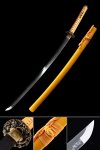 |
T10 Carbon Steel Katana with Real Hamon in Yellow Saya - Dragon Tsuba, Orange Cord Handle |
Christopher Kurilla
Pennsylvan, United States
True works of art, looking forward to adding more to my collection
|
T10 Carbon Steel Katana with Real Hamon in Yellow Saya - Dragon Tsuba, Orange Cord Handle |