
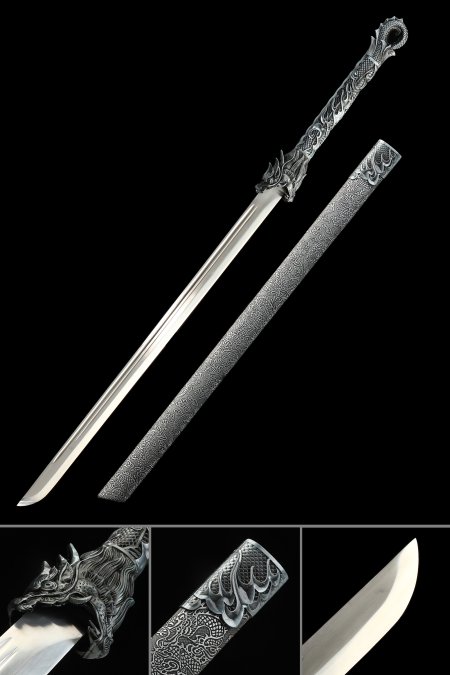
Black Straight Katana
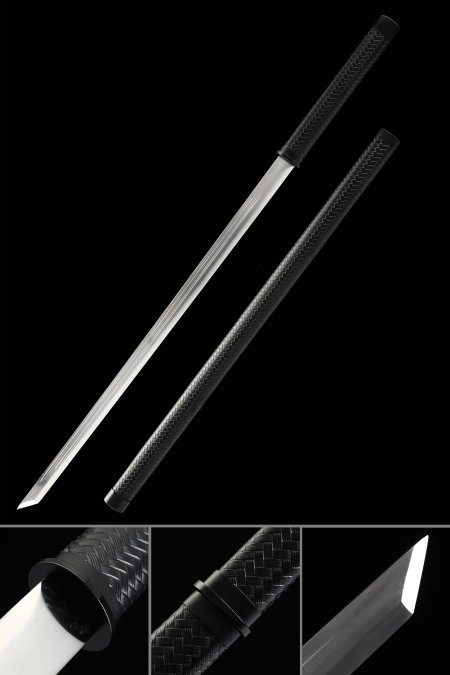
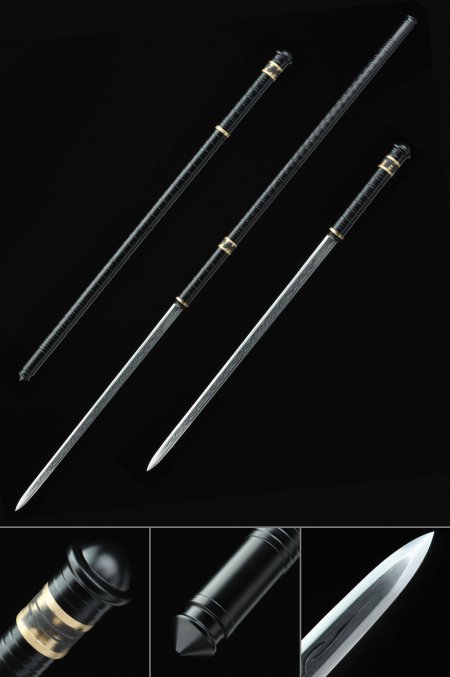
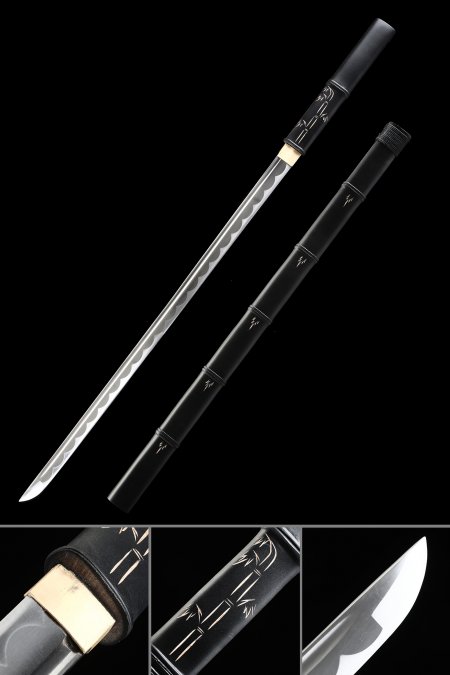
Explore our Black Straight Katana collection, where dark aesthetics meet angular blade geometry to create swords with distinctive modern character. These katana combine the commanding presence of all-black presentation with the clean, geometric lines of a straight blade profile — departing from the traditional curved silhouette to create pieces that feel contemporary, architectural, and visually striking in ways that curved blades approach differently. Free U.S. shipping and 30-day return guarantee.
FAST SHIP
Free Shipping
139.00 USD
ON SALE! 15% OFF
Was: 169.00 USD
FAST SHIP
Free Shipping
169.00 USD
ON SALE! 15% OFF
Was: 199.00 USD
FAST SHIP
Free Shipping
139.00 USD
ON SALE! 15% OFF
Was: 169.00 USD
FAST SHIP
Free Shipping
169.00 USD
ON SALE! 15% OFF
Was: 199.00 USD
Free Shipping
139.00 USD
ON SALE! 15% OFF
Was: 169.00 USD
FAST SHIP
Free Shipping
139.00 USD
ON SALE! 15% OFF
Was: 169.00 USD
FAST SHIP
Free Shipping
189.00 USD
ON SALE! 15% OFF
Was: 219.00 USD
FAST SHIP
Free Shipping
139.00 USD
ON SALE! 15% OFF
Was: 159.00 USD
Free Shipping
139.00 USD
ON SALE! 15% OFF
Was: 159.00 USD
FAST SHIP
Free Shipping
159.00 USD
ON SALE! 15% OFF
Was: 189.00 USD
FAST SHIP
Free Shipping
149.00 USD
ON SALE! 15% OFF
Was: 179.00 USD
FAST SHIP
Free Shipping
169.00 USD
ON SALE! 15% OFF
Was: 199.00 USD
FAST SHIP
Free Shipping
159.00 USD
ON SALE! 20% OFF
Was: 199.00 USD
Free Shipping
179.00 USD
ON SALE! 15% OFF
Was: 209.00 USD
Free Shipping
169.00 USD
ON SALE! 15% OFF
Was: 199.00 USD
Free Shipping
199.00 USD
Free Shipping
199.00 USD
Free Shipping
119.00 USD
ON SALE! 30% OFF
Was: 169.00 USD
Free Shipping
279.00 USD
Free Shipping
179.00 USD
ON SALE! 15% OFF
Was: 209.00 USD
Free Shipping
279.00 USD
Free Shipping
249.00 USD
Free Shipping
239.00 USD
Free Shipping
229.00 USD
Free Shipping
219.00 USD
Free Shipping
229.00 USD
Free Shipping
219.00 USD
Free Shipping
219.00 USD
Free Shipping
219.00 USD
Free Shipping
209.00 USD
Free Shipping
209.00 USD
Free Shipping
209.00 USD
Free Shipping
199.00 USD
Free Shipping
129.00 USD
ON SALE! 30% OFF
Was: 179.00 USD
Free Shipping
159.00 USD
ON SALE! 15% OFF
Was: 189.00 USD
Free Shipping
199.00 USD
Free Shipping
209.00 USD
Free Shipping
179.00 USD
Free Shipping
189.00 USD
Free Shipping
189.00 USD
Free Shipping
209.00 USD
Related Collections
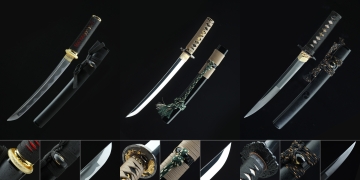
Black Tanto Sword59 items
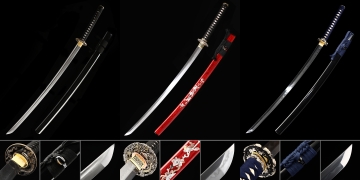
Black Dragon Katana13 items
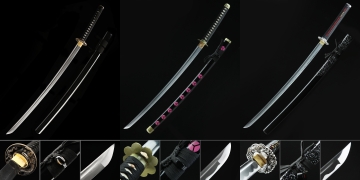
All Black Katana122 items
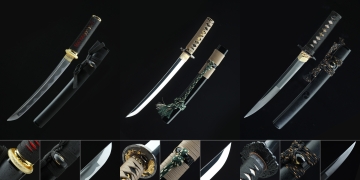
Black Tanto Knife59 items
Frequently Asked Questions
How does the straight blade profile on these katana connect to Japanese sword history and the chokut
Straight blades actually predate the curved katana in Japanese sword history. The chokuto — Japan’s earliest sword form, dating to before the 10th century — was a straight, single-edged blade influenced by Chinese and Korean sword design. The iconic curved profile that defines the katana developed gradually through the Heian period as swordsmiths discovered that differential heat treatment naturally induced curvature in the blade, and that this curvature enhanced cutting mechanics for mounted cavalry combat. Modern straight katana reference this pre-curve heritage while incorporating contemporary design sensibilities. When presented in black, these straight blades create a bridge between ancient Japanese blade-making origins and present-day minimalist aesthetics. They remind collectors that the Japanese sword tradition encompasses far more than the familiar curved silhouette — it includes an entire lineage of straight-blade design that preceded the katana era by centuries and continued to influence blade design throughout Japanese history.
What structural differences should collectors understand between straight and curved katana blade co
The structural differences between straight and curved katana go beyond visual profile and affect how the blade is forged, balanced, and assembled. Curved katana achieve their arc primarily through differential heat treatment: the cutting edge is hardened more than the spine, causing the edge to contract and the blade to curve during quenching. This means the curve is not just aesthetic — it is a physical expression of the blade’s internal hardness distribution. Straight blades, by contrast, are either heat-treated uniformly or use techniques that prevent curvature from developing, resulting in consistent hardness throughout the cross-section. This gives straight blades different mechanical properties: more predictable behavior under stress, with less of the directional cutting advantage that curved blades provide. The balance point also differs — straight blades tend to balance closer to the handle, creating a different feel in hand compared to the forward-weighted balance of curved katana. For display purposes, the key difference is visual: straight blades create a linear silhouette that reads as more architectural and modern, while curved blades create the organic sweep that defines traditional katana aesthetics.
Which black finish techniques work best on straight katana to achieve the most dramatic dark visual
Several black finish techniques are available for straight katana, each creating a different quality of darkness. The most dramatic is full blade blackening through controlled oxidation or specialized coating, which creates a completely black sword where blade, fittings, and scabbard merge into a single dark silhouette — this is the approach used in our all-black collection. Alternatively, a polished natural blade with black fittings and scabbard creates striking contrast between the bright steel line and the surrounding darkness, making the blade itself the visual focus. Black lacquer on the scabbard ranges from deep matte to high gloss, each creating different light interaction: matte black absorbs light for a stealth quality, while gloss black reflects the environment, creating a mirror-dark effect. The handle wrapping in black silk cord over black ray skin creates tonal unity on the grip. For the most contemporary visual effect on straight blades, matte black across all components produces the most architecturally clean result — the sword becomes almost a geometric shadow object that defines negative space in the display environment.
Are black straight katana suitable as the centerpiece of a first sword collection, or are they too s
Black straight katana make excellent collection centerpieces precisely because their distinctive character establishes a strong visual identity from the start. While they represent a specific aesthetic intersection rather than a broadly traditional design, this specificity is actually an advantage for new collectors: it makes a clear statement about the collector’s taste and creates a defined aesthetic direction that subsequent acquisitions can complement or contrast. A first collection built around a black straight katana as its anchor piece might add a traditional curved katana in natural colors for maximum contrast, then a tanto in matching black for scale variation within the dark theme. This creates a three-piece display with clear visual logic. The one consideration is that black straight katana occupy a contemporary niche — if your primary interest is in historically faithful traditional Japanese swords, a curved katana in traditional fittings would be a more contextually appropriate starting point. But for collectors who respond to the geometric, modern quality of black straight blades, there is no reason to start with something that does not excite you simply because convention suggests beginning with a traditional design.
Customer Reviews
Goku A
California, United States
Really happy with the purchase. Great craftsmanship for the price, and customer service got back to me quickly.
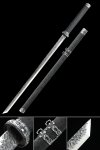 |
Ninjato 1090 Carbon Steel Hand-Hammered Blade with Black Dragon-Engraved Saya and Silver Scroll Tsuba |
Goku A
California, United States
Really happy with this purchase. Great craftsmanship for the price, and customer service was quick to respond.
|
Ninjato 1090 Carbon Steel Hand-Hammered Blade with Black Dragon-Engraved Saya and Silver Scroll Tsuba |
Kareem Andrews
Ohio, United States
Really love the sword. Better than I expected. Will definitely be a returning customer
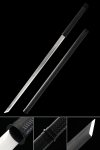 |
1045 Carbon Steel Ninjato Sword with Black Faux Leather Wrapped Saya in Full Tang Construction |
Deimos Boone
Georgia, United States
The quality is superb. I love the sharpness of the blade and it matches the other 2 blade that are almost identical to one another. By far one of the best purchases i made thus far when it comes to collecting blades.
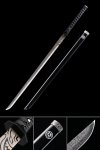 |
Kokushibo Ninjato in Manganese Steel with Crackle Hamon, Black Lacquer Saya & Dragon Kojiri |
Karen Mcmaster
Idaho, United States
My sons were very excited to get these katanas! Great service and I would recommend TrueKatana.com
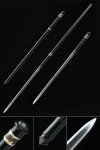 |
1045 Carbon Steel Expandable Spear Sword with Black Iron Saya and Brass Accents - Ninjato Collectible |
Jerome Wilson
Florida, United States
Second sword from these guys and I look forward to my third purchase!
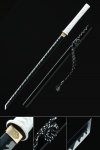 |
1095 Carbon Steel Straight Ninjato with Black Blade & White Ito - Piano Lacquer Saya |
William Ginipro
New Jersey, United States
2nd year I purchased my so one of the swords. He absolutely loves them. Becoming a Christmas tradition. Ordering easy, quality product, and quick delivery.
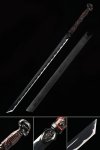 |
T10 Steel Clay-Tempered Ninjato with Skull Pommel in Black PU Leather Saya - Straight Ninja Sword |
Karoly Pum
Soer Troendelag, Norway
The sword is beautiful a bit heavy for single hand use i don't know yet how durable in real fight shortly will figure out.r
Was a very quick international delivery akso i surprised how cheap. Here in norway a quality sword start from 1000 $ for 170$ from usa i very happy with the company.
|
T10 Steel Clay-Tempered Ninjato with Skull Pommel in Black PU Leather Saya - Straight Ninja Sword |