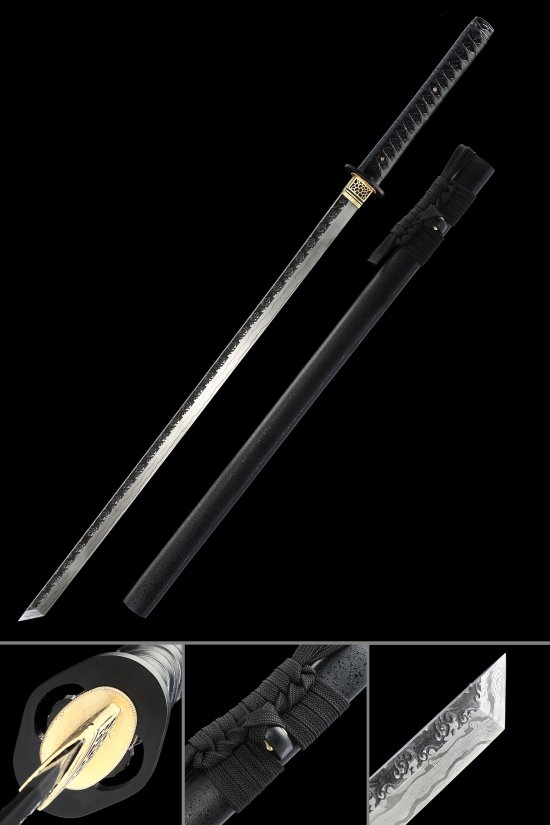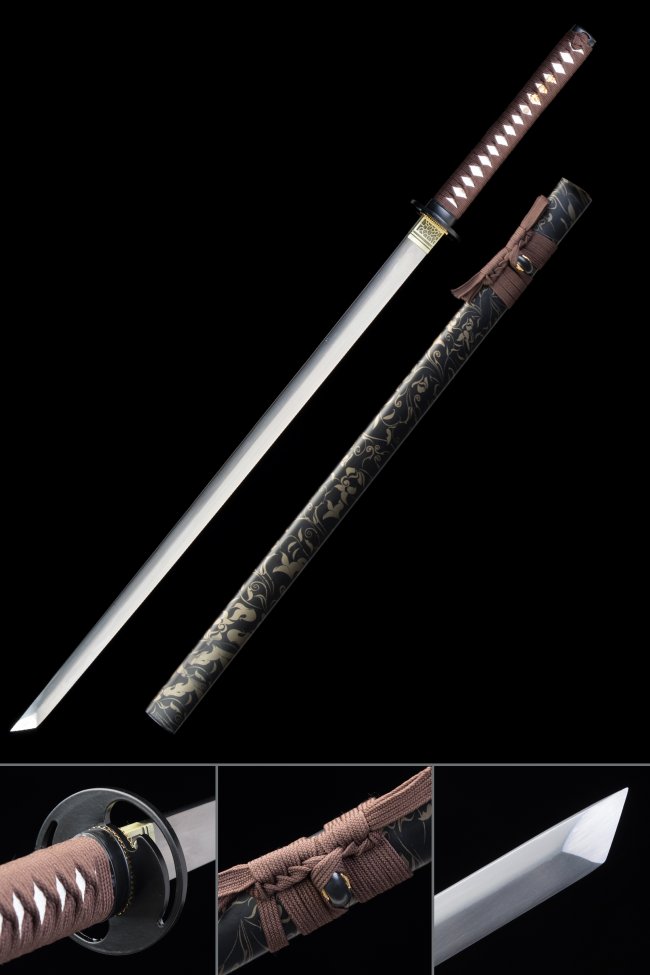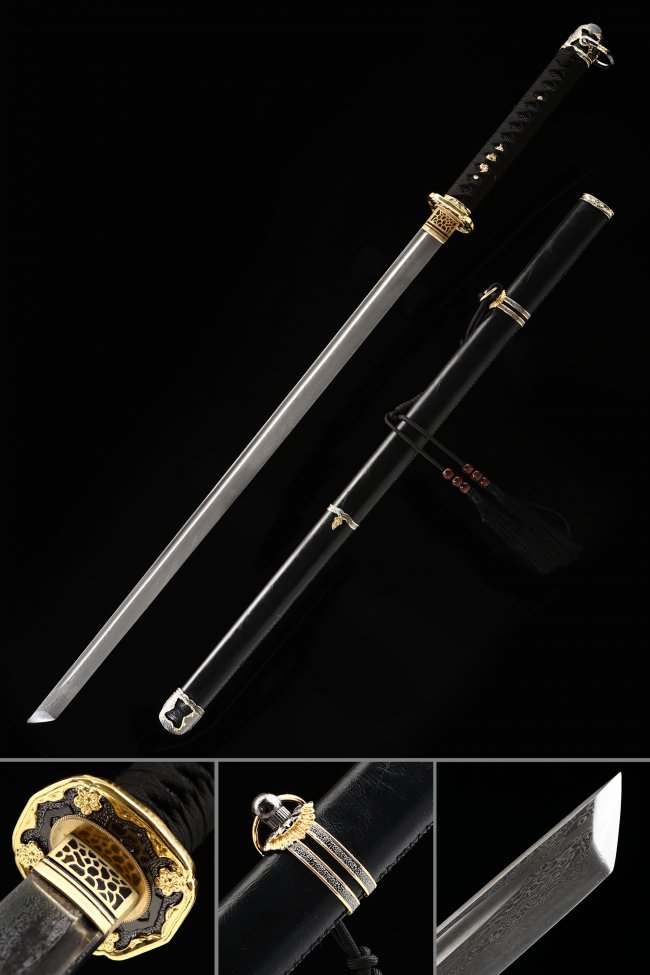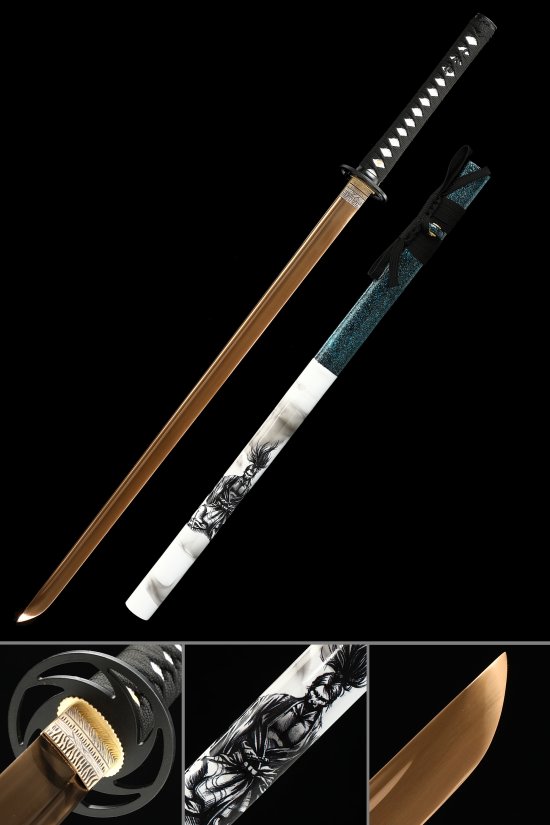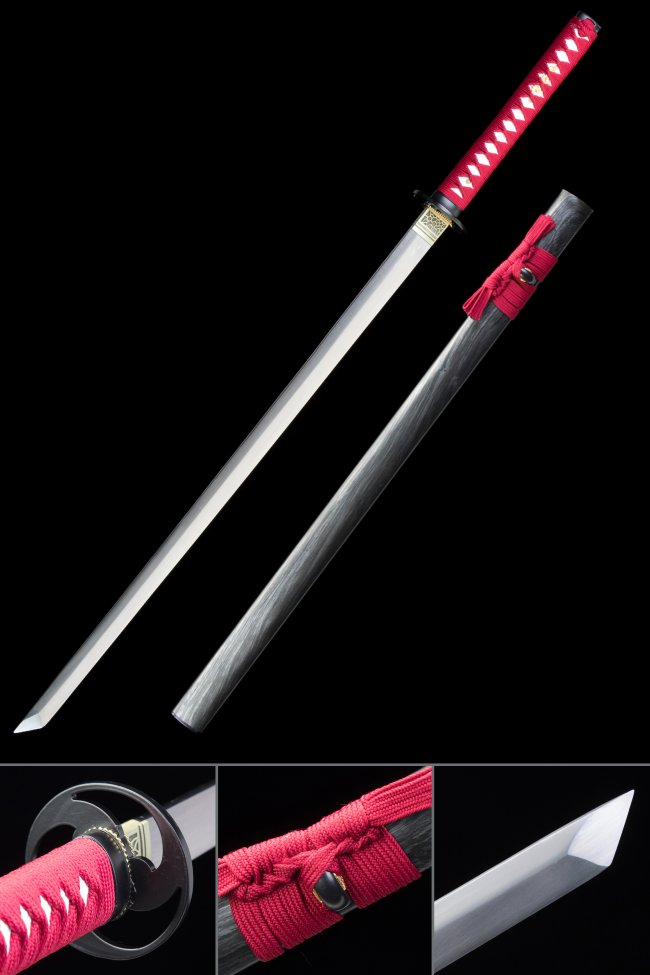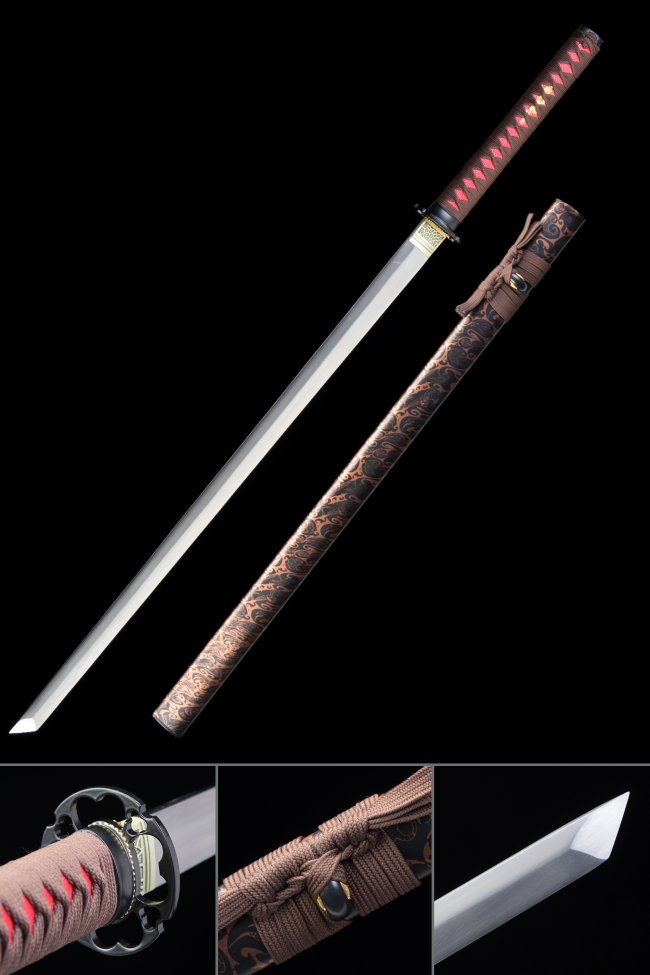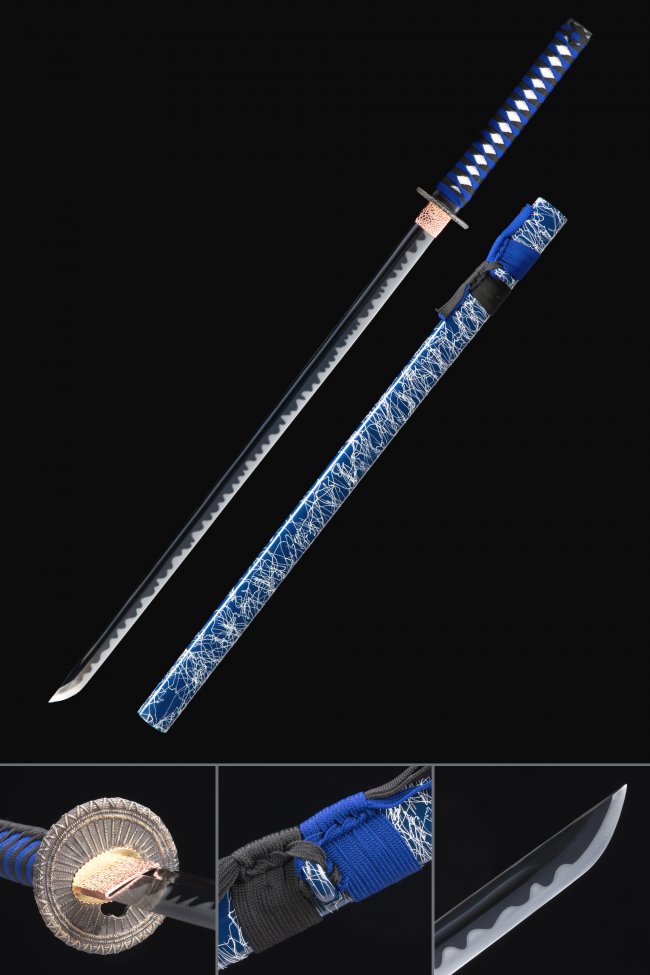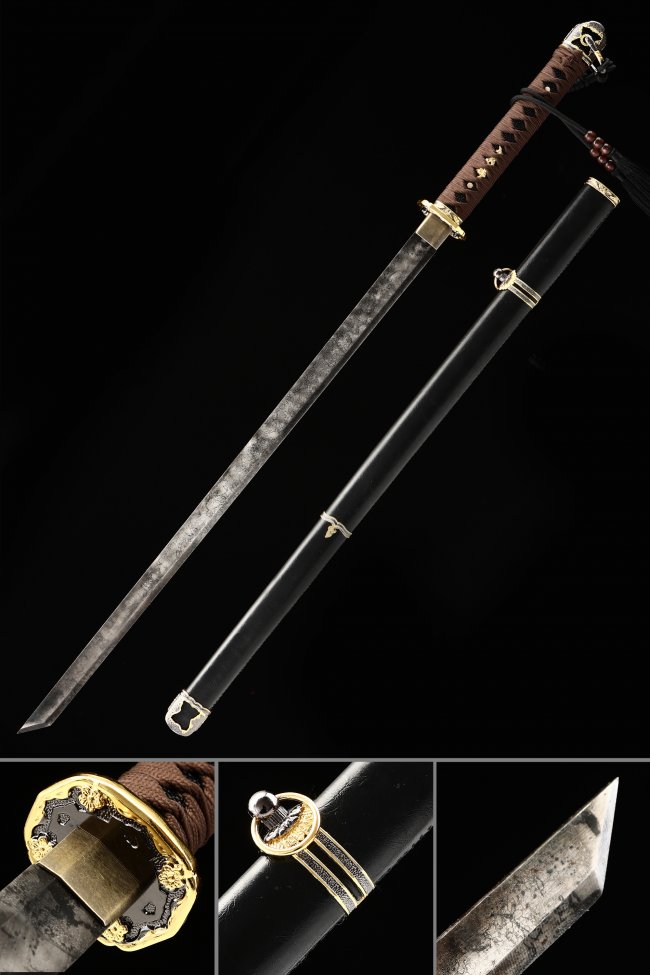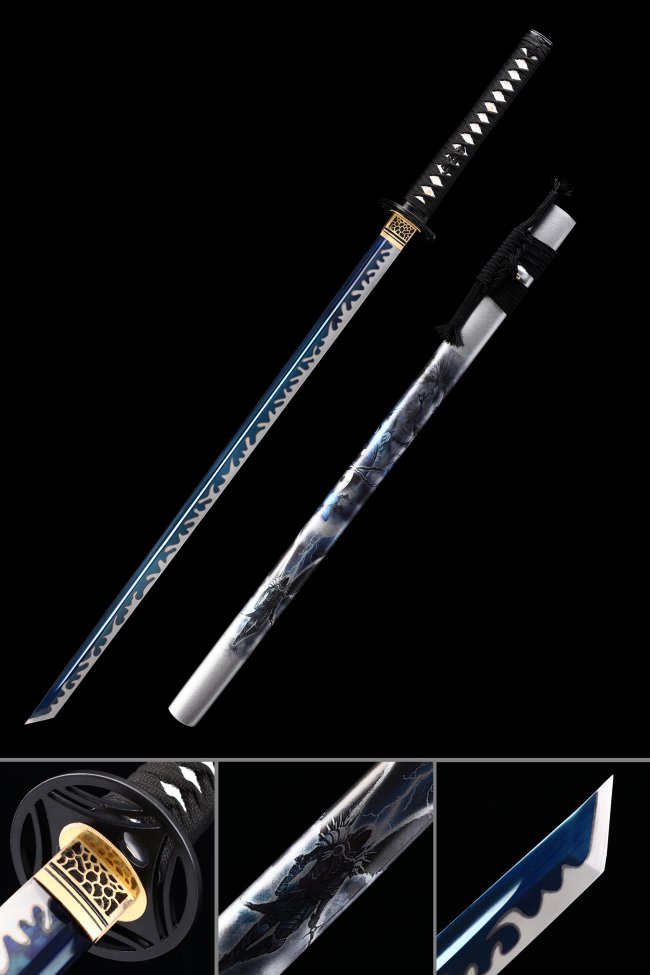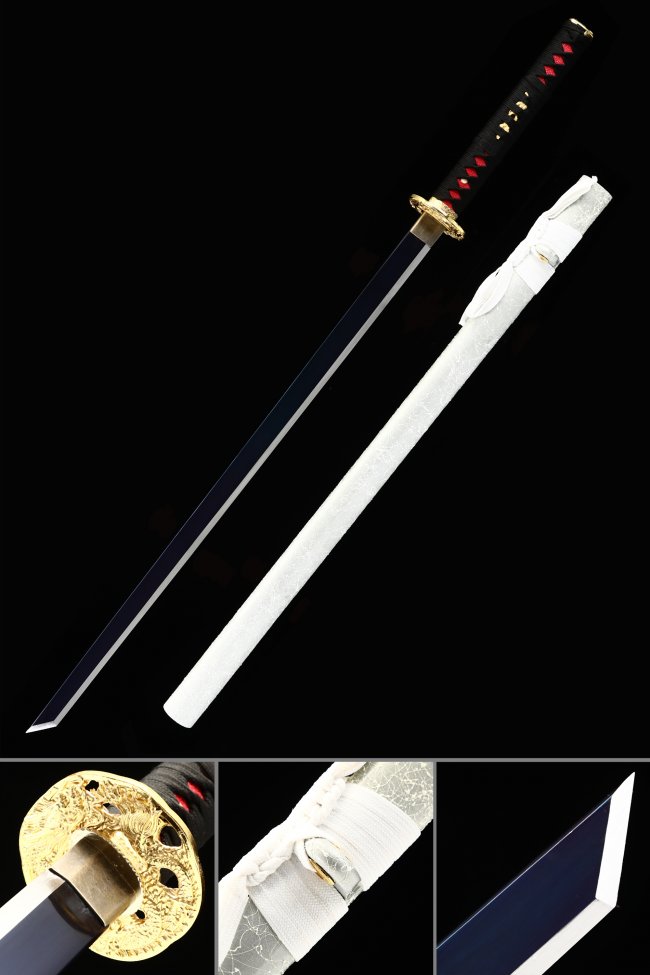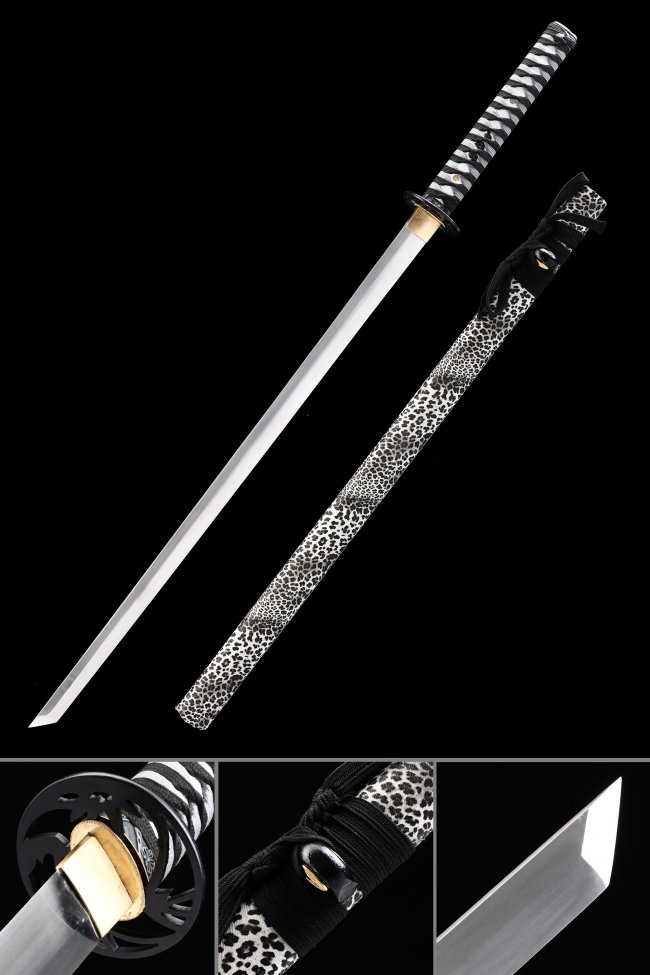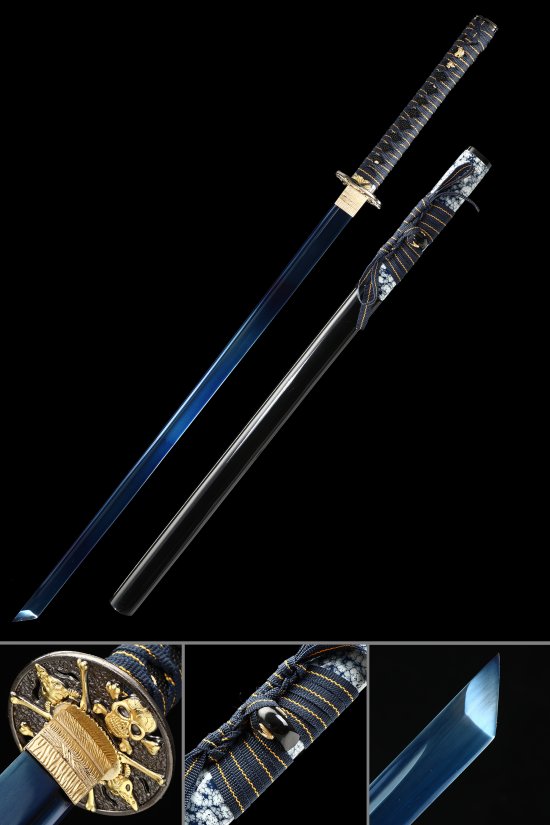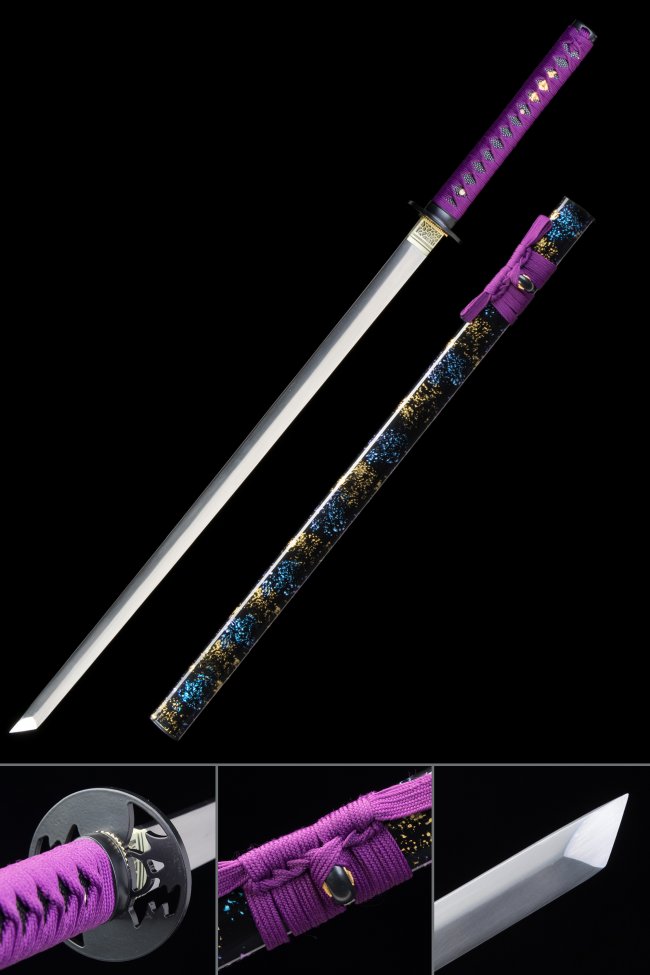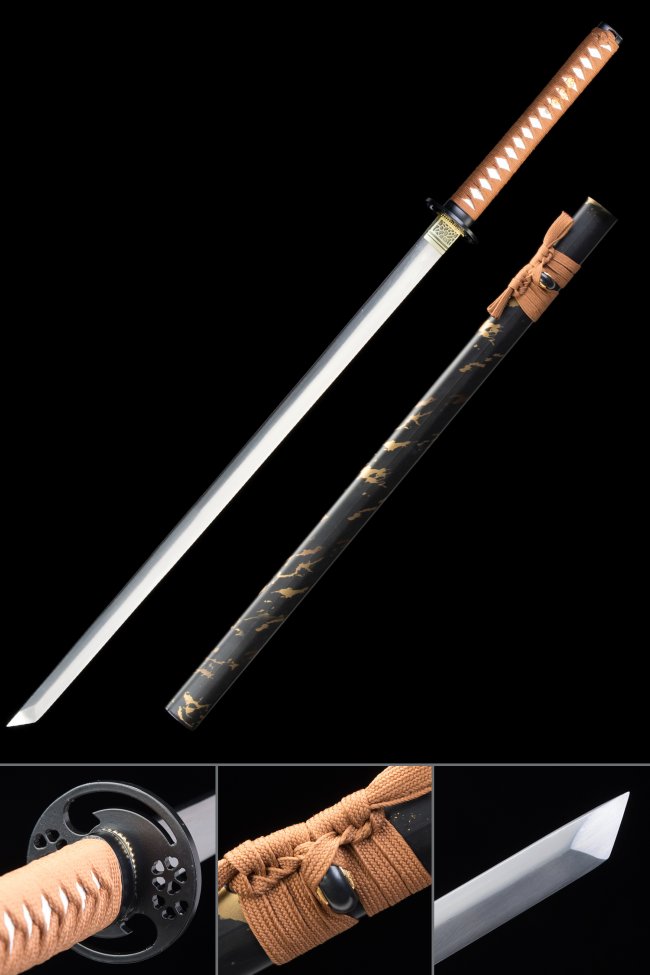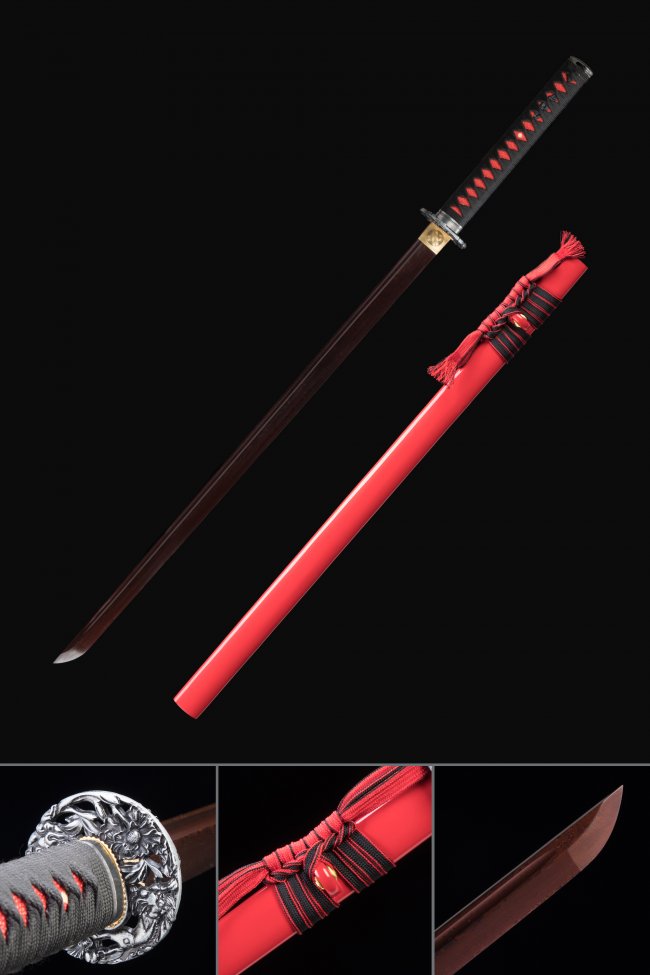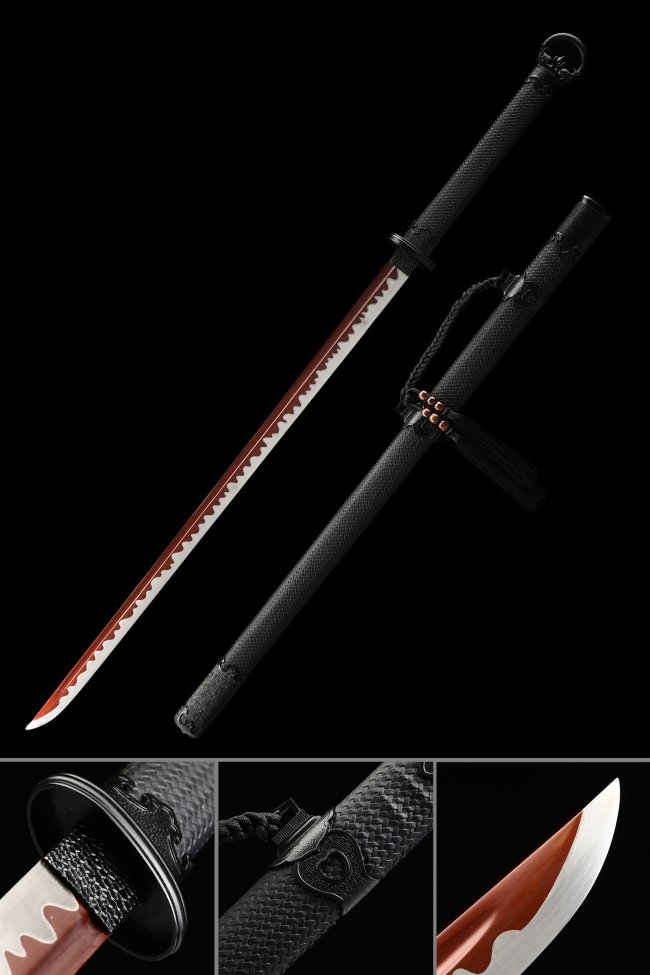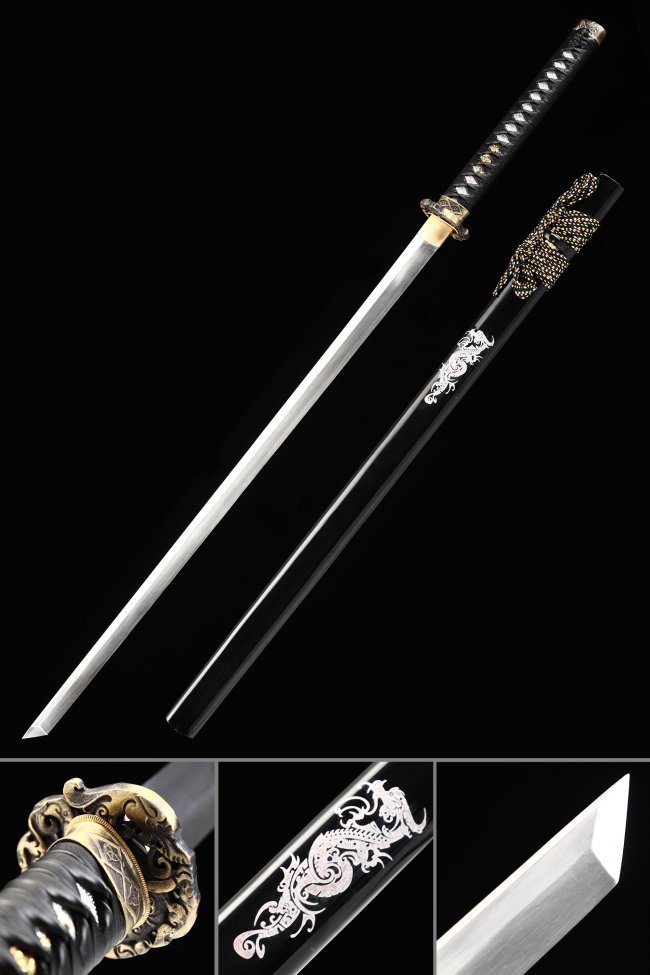
Straight Blade Katana
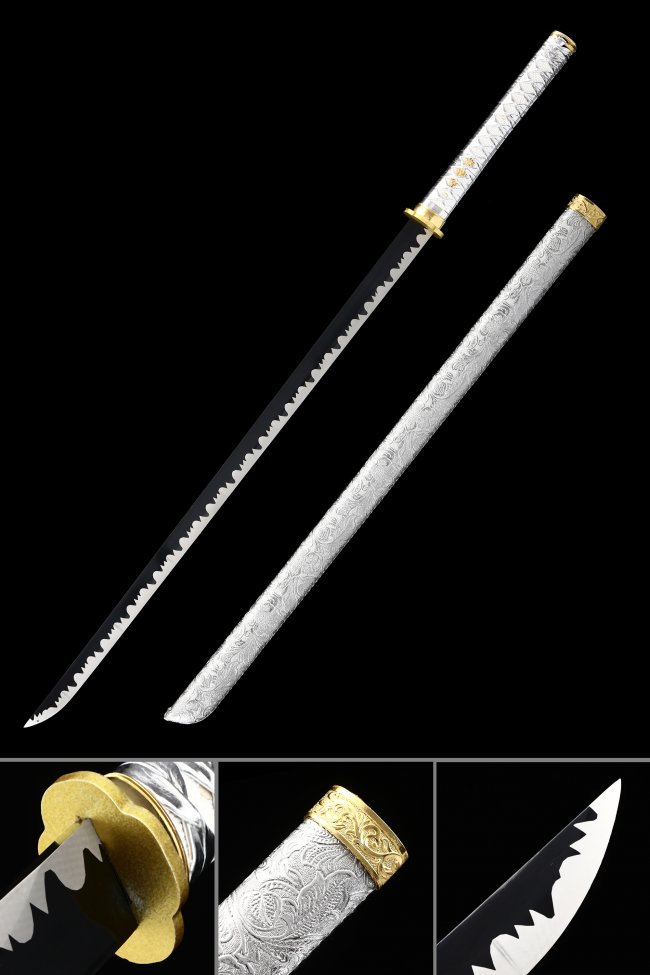
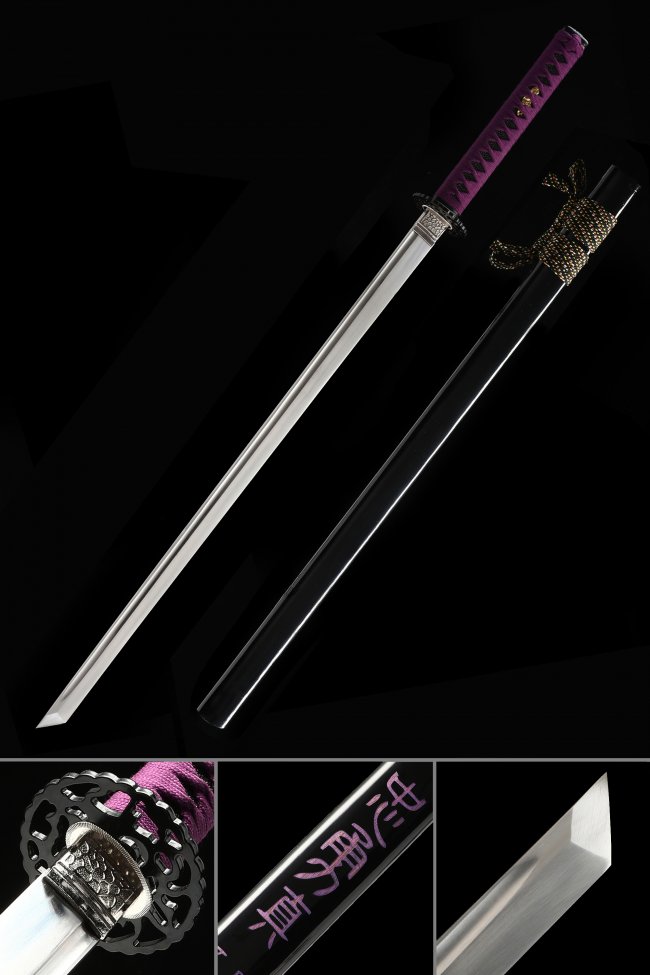
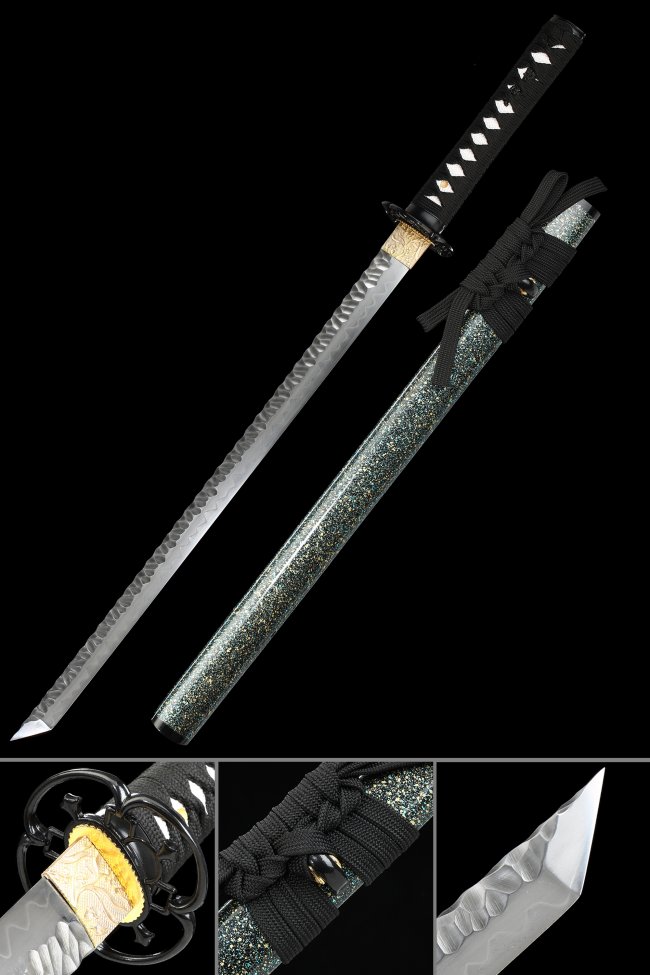
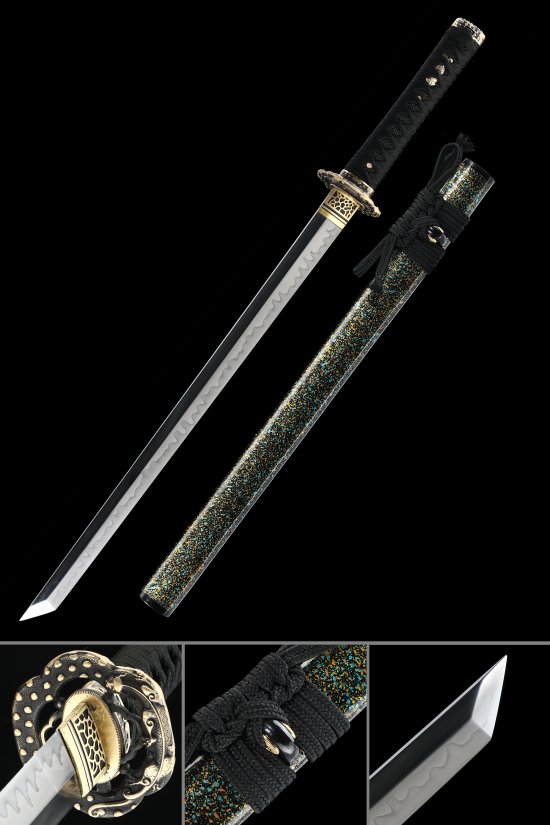
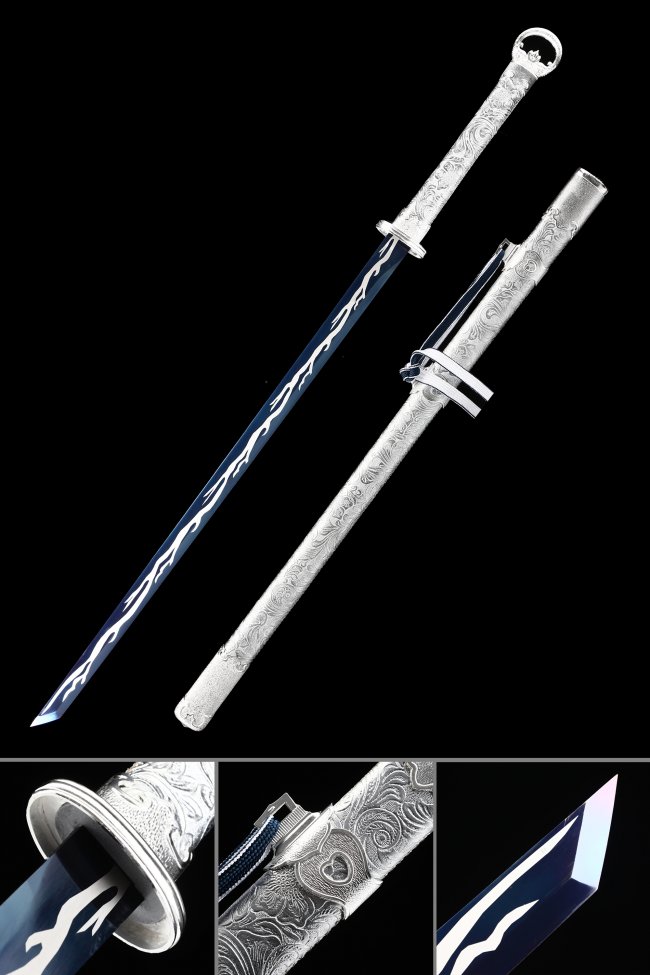
A straight blade katana drops the iconic curve and goes back to something older — the original Japanese sword profile that existed before the tachi and katana developed their signature bend. Every straight blade in this collection is hand-forged from high-carbon steel with full-tang construction, built for real use as well as display. The straight profile changes how the sword handles, how it cuts, and how it looks on a stand. For collectors drawn to the chokuto heritage or the ninjato tradition, these swords offer a fundamentally different experience from curved blades while staying rooted in authentic Japanese craft.

Related Collections
Frequently Asked Questions
What Is a Straight Blade Katana?
A straight blade katana is a hand-forged Japanese sword that uses a straight blade profile instead of the characteristic curve found on traditional katana. The blade has zero or near-zero sori — that's the Japanese term for the degree of curvature along the blade's length — which gives it a fundamentally different silhouette, balance, and handling feel from the curved swords most people associate with the samurai tradition. Everything else about the sword can follow traditional katana construction: a hand-forged carbon steel blade, full-tang construction with bamboo mekugi pins, ray skin and ito-wrapped handle, lacquered wooden saya, and metal fittings including tsuba, fuchi, kashira, and habaki. The only difference is that the blade runs straight from base to tip rather than following the gentle arc of a standard katana. This isn't a novelty design — straight blades actually predate curved ones in Japanese sword history. The earliest Japanese swords, influenced by Chinese and Korean designs, were all straight. The curve developed later as an optimization for mounted cavalry warfare, but the straight profile never fully disappeared from the tradition. Today, straight blade katana draw from two main design lineages: the chokuto, which represents the ancient straight sword tradition, and the ninjato, which represents the more modern ninja sword format. Both are available as functional, hand-forged samurai swords built with the same steel and construction methods used on curved blades, offering collectors and practitioners a genuinely different experience from the Traditional Katana while remaining rooted in legitimate Japanese blade craft. The straight profile appeals to buyers who want something visually distinct in their collection, who are interested in the older chapters of Japanese sword history, or who simply prefer the handling characteristics and direct cutting mechanics of a blade without curvature. It's a sword with genuine historical pedigree, real functional capability, and visual surprise is what makes the straight blade format so consistently appealing to serious collectors and casual buyers alike across every experience level.
Did Ninjas Actually Use Straight Swords?
This is one of the most debated questions in Japanese sword history, and the honest answer is that nobody knows for certain. The historical record on ninja weapons is extremely thin because secrecy was the entire point of the shinobi profession — they didn't leave detailed equipment catalogs behind. What historians generally agree on is that real ninja — the covert operatives of feudal Japan — probably used whatever weapons were available and appropriate for their missions rather than carrying purpose-built "ninja swords" that would immediately identify them as something other than ordinary travelers or merchants. A ninja sword as a distinct category really emerged more from 20th-century popular culture, martial arts movies, and the ninjutsu training schools that formalized ninja techniques into a teachable curriculum. That said, the argument for straight swords being useful to ninja makes practical sense. A shorter straight blade is easier to conceal, faster to draw in tight spaces, and more effective for thrusting — all qualities that align with what covert operatives would need. The square tsuba that's become standard on modern ninjato is sometimes explained as a foothold for climbing, though this is another claim that lacks definitive historical proof. Regardless of the historical debate, the Chokuto Ninjato has become a legitimate weapon category in modern martial arts and sword collecting. It has its own established design conventions, its own performance characteristics, and its own dedicated community of practitioners and collectors. Whether or not historical ninja carried exactly this type of sword, the modern ninjato works as a functional weapon and a compelling collector's piece on its own merits. The historical ambiguity is actually part of the appeal for many buyers — it connects the sword to a mysterious tradition that invites speculation and imagination rather than offering neat, settled answers. Whether you view the ninjato as a faithful recreation of a real covert weapon or as a modern martial arts tool inspired by a romanticized tradition, the sword itself is a capable, well-built piece of blade craft that performs its intended functions with genuine effectiveness and looks impressive on any display stand or in any training context.
Can You Cut with a Straight Blade Katana?
Yes — a functional straight blade katana with proper steel and construction cuts through standard tameshigiri targets with real authority, though the cutting mechanics feel different from a curved blade and reward a slightly different technique. On a curved katana, the sori creates a natural slicing action as you swing — the curve draws the edge across the target material, which is why even imperfect cuts on a curved blade can still go through cleanly. A straight blade removes that built-in assist. You're pushing the edge straight through the target rather than drawing it across, which means your edge alignment and swing path matter more. Clean cuts on a straight blade feel more direct and impact-oriented — closer to a chop than a slice — and the feedback is more honest about your technique. A sloppy swing that might still cut through on a curved blade can produce a ragged result or stall partway on a straight one. That honesty is actually valuable for training, because it highlights and corrects bad habits faster than a forgiving curved blade would. For functional cutting, you need the same specifications as any cutting sword: carbon steel at 1060 grade or higher, full-tang construction, and a properly sharpened edge. A Sharp Katana with a straight blade in the right steel grade handles tatami mats, bamboo, and water bottles effectively — the targets don't care whether the blade is curved or not. Where the straight blade genuinely outperforms curved options is in thrusting. The linear profile transfers thrust energy directly into the target without deflection from curvature, making penetration deeper and more controlled with the same force input. A Clay Tempered Katana with a straight profile gives you a differentially hardened blade — hard edge for cutting, tough spine for resilience — that works in the same functional way on a straight blade as it does on a curved one, proving that the heat treatment benefits are about metallurgy, not blade geometry. The bottom line is straightforward: if you buy a straight blade in the right steel with proper construction, it cuts. The mechanics are different from a curved blade, but the capability is real and the results at the cutting stand speak for themselves once you adjust your technique to match the tool.
What Is the Difference Between a Chokuto and a Ninjato?
Both are straight Japanese swords, but they come from different design traditions and serve different purposes in modern collecting and martial arts. The chokuto is the historical original — Japan's earliest sword type, dating back to before the curve was ever introduced into Japanese blade design. Historical chokuto were influenced by continental Asian sword-making traditions and ranged from simple, utilitarian single-edged blades to elaborately decorated court swords with ornate fittings and gold inlay. Modern chokuto reproductions tend to emphasize the historical connection, often featuring fittings inspired by Kofun or Nara period originals and blade profiles that reference specific museum pieces or documented historical designs. The ninjato, by contrast, is a more modern category that draws from the ninja tradition — whether historically accurate or culturally constructed — and features a standardized design: a roughly 20-to-24-inch straight blade, a square tsuba, and relatively plain, utilitarian fittings that prioritize function over decoration. It's the practical, no-nonsense interpretation of the straight blade. A Hand Forged Ninjato is built for use, with the kind of straightforward construction that emphasizes reliability over artistic expression. The two categories also differ in collector appeal. Chokuto attract history enthusiasts and serious scholars of Japanese sword evolution who want a tangible connection to the oldest chapter of the tradition. Ninjato attract a broader audience that includes martial artists, pop culture fans, and collectors who appreciate the distinct aesthetic and functional personality of the ninja sword format. There's overlap — plenty of collectors own both — but the motivations and interests that draw people to each type tend to be different. An Authentic Ninjato prioritizes period-appropriate construction and materials, while a modern ninjato might incorporate contemporary steel options and design touches that wouldn't have existed historically but enhance the sword's performance and visual appeal for today's users. Owning both a chokuto-style sword and a ninjato gives you the full range of the straight blade tradition in a single collection — the historical depth of one paired with the practical versatility of the other, covering different aesthetic territory while sharing the same fundamental blade geometry that makes straight Japanese swords their own distinct and rewarding category.
What Steel Is Best for a Straight Blade Katana?
The same steel grades that work well on curved katana perform equally well on straight blades, and the selection logic is identical: match the steel to your intended use and budget. For display-oriented pieces that won't see regular cutting, 1045 carbon steel provides a functional blade at the most accessible price point. It holds a reasonable edge and displays well, but it lacks the hardness and edge retention for serious tameshigiri work. The 1060 grade is where functional straight blades begin — tough enough for regular cutting, resistant to bending, and priced in the middle range that balances capability against cost. This is the grade most practitioners settle on for a straight blade they plan to actually use at the cutting stand. For premium performance, 1095 Carbon Steel Katana blades deliver excellent edge retention and produce vivid hamon lines through clay tempering. On a straight blade, the hamon runs as a long, unbroken wave from base to tip — visually distinct from the curved hamon on a standard katana and arguably more dramatic because the straight profile presents it as a continuous, undistorted line. T10 Carbon Steel Katana options offer similar premium performance with tungsten in the alloy for tighter grain structure and improved toughness at high hardness levels. Damascus and folded steel are particularly effective on straight blades because the layered surface pattern runs the full length without curvature distortion — the visual effect is cleaner and more uniform than on curved blades, which makes these patterned steels especially popular among straight blade collectors who want maximum visual impact from their blade finish. The one consideration specific to straight blades is that they tend to be slightly stiffer than equivalent curved blades because the straight geometry doesn't distribute flex the way a curve does. This makes spring steel an interesting option for practitioners who do a lot of heavy cutting and want a blade with built-in flex resistance that returns to true after bending stress. Whatever grade you choose, the key principle holds: invest in the steel, because on a straight blade where the profile draws the eye along the full length without curvature, every aspect of the blade finish and surface quality is on full display with nothing to distract from it.
Are Straight Blade Katana Good for Martial Arts Training?
They're excellent training tools, though they serve a different purpose than curved training swords and work best as supplementary equipment rather than a complete replacement for standard katana in most martial arts curricula. The straight blade's most valuable training function is improving edge alignment and cutting technique. Because a straight blade doesn't have the built-in slicing advantage of curvature, every cut requires more precise alignment to go through cleanly. Practitioners who train regularly with straight blades develop better edge control, more consistent swing paths, and a stronger awareness of how small changes in angle affect cutting results. That technical precision carries directly back to curved-blade practice, making the student more effective with both weapon types. For thrusting-focused training — tsuki work in kendo, iaido, or classical Japanese sword arts — the straight blade is the natural choice. The linear profile aligns with the thrust direction perfectly, providing the most direct feedback on thrust mechanics and targeting accuracy. A Practice Katana with a straight blade gives you a dedicated thrusting trainer that no curved sword can match for this specific skill. The straight blade also introduces variety into training sessions in a way that keeps practitioners engaged and prevents the plateau effect that can set in when you train with the same equipment day after day. Switching from a curved blade to a straight one — even within the same training session — forces your body and mind to adapt to different balance, different cutting dynamics, and different timing, which builds overall sword handling adaptability. A Training Katana with a straight profile broadens your training toolkit and pushes development in directions that curved-blade-only practice simply cannot reach. Some traditional Japanese martial arts schools incorporate straight blade training specifically for these benefits, recognizing that the chokuto tradition predates the curved katana and offers legitimate historical techniques worth preserving and practicing alongside the more common curved-blade curriculum. Even if your primary training weapon stays curved, having a straight blade in your training rotation adds a dimension of skill development that makes you a more complete, more adaptable, and more technically aware swordsman overall across every blade type you pick up.
What Is the History of Straight Swords in Japan?
Straight swords were the original Japanese blade form, and they dominated Japan's weapon landscape for centuries before the curved tachi emerged and eventually evolved into the katana. The earliest Japanese swords — broadly classified as chokuto — date to roughly the 3rd through 7th centuries and show strong influence from Chinese and Korean blade-making traditions. These were straight, single-edged or occasionally double-edged blades that ranged from short personal weapons to full-length military swords. During the Kofun period, straight swords were the standard issue weapon for warriors, and some of the finest surviving examples feature elaborate fittings with gold and silver inlay, jeweled pommels, and decorative scabbards that prove they were prestige objects as well as functional weapons. The transition from straight to curved blades happened gradually during the Heian period, roughly the 9th and 10th centuries, as Japanese swordsmiths began developing blade forms better suited to the mounted cavalry warfare that was becoming increasingly important. The curve improved cutting efficiency from horseback by creating a natural slicing action during the draw, and it distributed impact stress more effectively along the blade's length. By the late Heian and into the Kamakura period, curved tachi swords had become the dominant military weapon, and straight designs fell out of mainstream military use. But they never vanished completely. Straight blades persisted in specific contexts — as samurai swords for ceremonial use, as votive offerings at temples and shrines, as tanto and personal weapons where the straight profile's thrusting advantage was valued, and in the various traditions that would eventually be associated with the shinobi. The Authentic Japanese Katana tradition today encompasses both curved and straight designs as legitimate expressions of a blade-making heritage that spans over 1,500 years, with the straight sword representing the older and in some ways more foundational chapter of that story. Owning a straight blade katana connects you to that earliest period directly — a tangible link to the very beginning of the Japanese sword tradition, when every blade was straight and the curved katana that would later define an entire martial culture was still centuries away from being forged for the first time.
Can I Get a Straight Blade Without a Guard?
Yes — the straight blade and guardless mounting styles combine naturally, and the result is one of the cleanest, most minimalist sword profiles available in Japanese blade craft. A Straight Katana Without Guard eliminates both the blade curvature and the tsuba, leaving a sword that reads as a single, uninterrupted line from pommel to tip. The visual effect is strikingly modern despite being rooted in historical traditions — the aikuchi (guardless) mounting and the straight blade both predate the curved, guarded katana that most people consider the "standard" configuration. Combined, they create a sword with the most pared-down aesthetic possible while still maintaining traditional handle construction with ito wrapping, ray skin, and proper fittings. For collectors who appreciate minimalist design, the guardless straight blade represents something close to the ultimate expression of reduction in a Japanese sword — every element that can be removed has been removed, leaving only what's structurally necessary for a functional weapon. A Guardless Katana with a curved blade achieves a similar minimalism in a more traditional silhouette, but the straight guardless version pushes the concept further by eliminating the visual softness of the curve as well. The combination works well on display because the absolutely straight, absolutely clean profile creates a geometric statement that's more like a piece of architectural design than a traditional weapon. On a wall mount, a guardless straight blade hangs as a perfect straight line — no curve breaking the geometry, no guard interrupting the flow. For practical use, the guardless straight blade handles like any other guardless sword, with the same caveat about hand safety during thrusting that applies to all swords without a tsuba. The straight profile actually makes the guardless configuration slightly more comfortable for thrusting-focused users, because the forward hand sits behind the habaki without a curved blade angling away from the grip line. If pure minimalism is what you're after — a sword stripped to its absolute geometric essence with no curve and no guard — this combination delivers exactly that, and it creates one of the most visually distinctive display pieces in all of Japanese sword collecting.
Are Straight Blade Katana Good for Beginners?
Straight blade katana can work well for beginners, but with some important context that helps new buyers make the right choice. For a first-ever Japanese sword purchase with the primary goal of display and collecting, a straight blade katana or ninjato is a perfectly good starting point. The visual appeal is strong, the price range includes accessible entry-level options, and the straight profile adds something genuinely different to a new collection right from the start. A Folded Steel Katana with a straight blade gives a beginner collector a sword with impressive visual detail — the layered surface pattern of folded steel is especially clean and dramatic on a straight blade — at a price point that doesn't require a massive initial investment. For beginners interested in martial arts and cutting practice, the situation is more nuanced. Most Japanese sword arts — iaido, kendo, kenjutsu — teach curriculum designed around curved blades, so starting with a straight blade means your training tool doesn't match the weapon the techniques were designed for. That's not a dealbreaker, but it does mean adjusting your expectations and possibly supplementing with a curved blade for technique-specific practice. On the other hand, some practitioners and instructors argue that starting with a straight blade develops better fundamental edge alignment because the blade doesn't offer the forgiveness of curvature during cuts. A Real Hamon Katana in straight profile with a clay-tempered blade gives a beginning practitioner a fully functional sword with the added visual benefit of a vivid temper line that proves the blade was properly heat treated. For beginners who know they want to focus on ninjutsu, straight blade work, or who simply love the straight blade aesthetic above all else, there's no reason not to start with one. The sword cuts, it trains grip discipline effectively, and it provides the experience of owning and handling a real hand-forged Japanese sword. Just understand that the straight blade is a specific branch of the broader tradition, and most martial arts contexts eventually require familiarity with curved blades as well. But as a first sword or an early addition to a growing collection, a straight blade katana brings something genuinely different to the table and provides a foundation of appreciation for the full breadth of Japanese sword design.
Customer Reviews
Like a true ninja it appeared on my doorstep. Beautiful work and it’s a real sword. Heavier than I expected and really solid. A beautiful piece of art that’s fully functional. Came from China and arrived really quickly. Thanks True Katana. Expect a few more orders from me in the near future
![]() |
T10 Carbon Steel Ninjato with Hamon Blade in Multi-Color Glitter Saya - Black Cord Handle |
A lot more heft than I thought. But great for training, and it’s beautiful.
![]() |
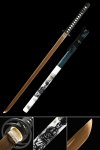
1095 Carbon Steel Ninja Sword with Gold Blade - Teal-White Painted Saya, Black Ito |
The sheath was broken on arrival but that’s okay the sword was beautiful
![]() |
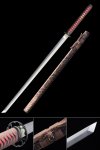
Chokuto Sword 1060 Carbon Steel - Brown-Red Cord Handle, Dragon Patterned Brown Saya |
It arrived quickly. Delivered with care.r
r
This would be my sixth.r
r
This one, like Rengoku's Flame Nichirin, arrived scalpel sharp.r
Be very careful. r
High quality. Excellent site.r
r
Helpful online assistance, should you ever need it.
![]() |
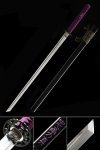
Manganese Steel Straight Sword with Purple Ito, Black Lacquer Saya - Law Replica |
This was my first sword purchase and it was an amazing experience. I like how the sword is designed to the feel of it and it's a fine looking sword.
![]() |
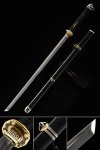
WWII Type 98 Shin Gunto Damascus Steel Sword with Gold-Black Tsuba in Black Lacquer Saya |
I like this katana very much. Weight feels good in my hand. Easily makes "swoosh"
The golden blade looks awesome and is sharp. Handle is tight and consistent. I have other samurai katanas, finally got a ninja katana and is excellent. I'm digging the Ninja Scroll looking graphic.
1095 golden bladed ninja sword rocks!!
Tony D.
![]() |
1095 Carbon Steel Ninja Sword with Gold Blade - Teal-White Painted Saya, Black Ito |
My 8th sword from truekatana.Im very impressed with my leopard print ninjato.Thank you senior sword maker and staff.
![]() |
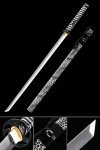
Manganese Steel Ninjato with Leopard Print Saya - Chokuto Straight Blade, Black & White Ito |
Good value for the price. I am impressed with the detail and quality of the sword.
Well done.
Thank you!
![]() |
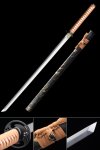
1060 Carbon Steel Chokuto Ninjato in Black-Gold Cloud Saya with Brown Cord Handle |